

Search "dumpster rental" plus the name of your town. Count how many results on the first page belong to a company that actually owns trucks and containers in your area. For many independent haulers, the answer is uncomfortable. The top spots go to national brokers and lead-generation sites with a page for every city in the country. Some of those jobs end up back with you anyway, as a subcontracted order at a price the broker set, with the broker keeping a cut and the customer relationship. You own the equipment, you know the local roads and permit rules, and you do the work. The broker owns the search result. That can be changed. Brokers win on scale, but scale has limits. They can't show the local proof, speed, and accountability that a real local company can. This post shows how to find where brokers are beating you and how to take those searches back one town at a time. How Dumpster Brokers Work and Why They Rank Dumpster brokers generally don't own a fleet in your market. They take the order online or by phone, then send it to a local hauler to fulfill. Some sell the same lead to several haulers at once. Either way, the broker earns money from the gap between what the customer pays and what the hauler receives. They rank well for a few reasons: Large, established websites. A national site that has been building links for years carries a lot of authority with Google. A page for every town. Brokers publish thousands of city pages. Even thin pages can rank when the domain behind them is strong. Big ad budgets. They can afford to bid on nearly every dumpster keyword in every market. Sometimes, questionable Maps listings. Some lead-generation operations create Google Business Profiles at addresses where no real dumpster business operates. Trying to beat them on scale is a losing fight. Beating them on local detail is where you win. Step 1: Map Where Brokers Are Beating You Before changing anything, find out exactly where you're losing. Pick your 10 most important searches and check them for each of your main towns. Searches to check (adjust to your market): dumpster rental [town] roll off dumpster [town] 20 yard dumpster [town] dumpster rental near me (searched from that town, or with a location tool) cheap dumpster rental [town] For each search, write down: Who holds the top Google Ads spots Who shows up in the Map Pack Who ranks in the top five organic results Whether each one is a local hauler or a broker Use a private or incognito browser window so your own search history doesn't skew the results. Put everything in a simple spreadsheet. After an hour you'll have a clear picture of which towns and keywords brokers control, and where you're already close to the top. Step 2: Report Maps Listings That Break Google's Rules Google's guidelines require a Business Profile to represent a real business that serves customers in person. A listing created only to capture leads for resale, or placed at an address where no real business operates, may not meet those rules. If you find a listing that looks suspicious: Check the address on Street View. Is it a residence, a mailbox store, or an empty lot with no sign of a dumpster business? Call the number and ask a few simple questions. Who owns the trucks? Where is the yard? Who will actually deliver? If the listing clearly breaks the rules, use "Suggest an edit" on the listing or submit Google's Business Redressal Complaint Form with your evidence. Be careful and fair here. Only report listings you have good reason to believe are fake or misleading. Reporting a real competitor because they outrank you is a waste of time and can hurt your credibility with Google. Step 3: Build Town Pages Brokers Can't Copy A broker's city page usually says the same thing for every town with only the name changed. Your town pages should include details that only a company working in that area would know. What to put on each town page: Where you're located. Name your yard location and the drive time to that town. For example (use your own details): "Our yard is 12 minutes from downtown Springfield, so most deliveries arrive the same day." Local permit rules. Explain whether a street placement needs a permit in that town and how to get one. Neighborhoods you serve. List them by name. Photos from real jobs in that town. Include a short caption with the project type. Local disposal knowledge. Mention how you handle materials that the local transfer station or landfill treats differently, such as yard waste or concrete. A review from a customer in that town, if you have one. A broker can publish ten thousand pages, but it can't photograph your containers on driveways in your towns. That kind of local proof is hard to fake, and it gives both customers and search engines a clear reason to choose you. Start with your most profitable towns from Step 1 instead of trying to build every page at once. A few strong pages beat dozens of thin ones. Step 4: Make "Book Direct With the Local Hauler" Your Selling Point Many customers don't know the difference between a broker and a local hauler until something goes wrong. A different company shows up than the one they called, or they can't reach anyone who knows the status of their delivery. You can make that difference clear without attacking anyone. Ways to show you're the real local company: Say it plainly on your homepage and ads. For example: "Locally owned. Our trucks, our containers, our drivers." Adjust the wording to fit your business. Show your people and equipment. Use real photos of your team, your trucks, and your yard instead of stock images. Publish a "Why Book Direct" page. Explain the benefits in plain terms: one company from quote to pickup, a direct phone line to dispatch, local knowledge of permits and placement, and no middleman in the price. Use your name when you answer the phone. Answering with your company name and speaking directly about scheduling builds trust right away. Keep the message focused on what you offer. Customers respond better to a clear promise than to criticism of competitors. Want to see exactly where brokers are taking your searches? In a Free Strategy Session , we'll map broker competition across your service area and show you which towns you can win back first. Step 5: Compete Where Brokers Are Weakest Brokers are built for volume. That leaves gaps a local operator can fill: Speed. You control your own schedule. If you can deliver same day or next day, say it everywhere and back it up. Clear pricing. Show your price range, rental period, weight allowance, and overage fees upfront. Customers comparing options appreciate knowing exactly what they'll pay and who they'll pay. Flexibility. You can make judgment calls a broker can't, like extending a rental by a day, fitting a container into a tight driveway, or swapping a size on short notice. Accountability. When something goes wrong, the customer talks to the company that can fix it. Pick the two or three strengths that fit your business best and repeat them across your website, ads, and phone conversations. Step 6: Use Paid Search Where It Counts You can't outspend a national broker across every keyword and town, and you don't need to. Focus your paid budget where your local advantage is strongest. Bid on your own brand name. Brokers and competitors sometimes bid on local company names. A small brand campaign makes sure customers searching for you find you first. Target your core towns tightly. Concentrate your budget on the towns closest to your yard, where you can deliver fastest and profit most. Write ads that say "local." Mention your town, your fleet, and your delivery speed in the headlines. Send clicks to your town pages, not your homepage, so the ad and the page match the customer's search. Step 7: Earn Local Links and Mentions Brokers Can't Get National brokers collect links at a national scale. What they rarely have is real standing in your community. Those local signals help you in both search and Maps. Local link and mention ideas: Membership in your chamber of commerce and local business associations Sponsoring a youth sports team, community cleanup, or school event Vendor or partner pages from local roofers, remodelers, and property managers Coverage in local news when you donate a container or help after a storm Listings with your city or county as a waste hauling vendor, if they offer one Each one is a small signal on its own. Together, they tell Google you're a real part of the community in a way a national broker isn't. Should You Accept Broker Jobs at All? This is a business decision, and there's no single right answer. Broker work can fill empty containers during slow weeks. But it usually comes with lower margins, less control over pricing, and a customer who remembers the broker's name, not yours. If you take broker jobs, set some rules: Track the real margin on every broker job after fuel, dump fees, and driver time. Use broker work to fill gaps, not as your main source of bookings. Deliver excellent service anyway. Leave a door hanger or magnet with your company name so the customer can book direct next time, as long as your agreement with the broker allows it. Watch your dependence. If broker jobs grow as a share of your business, treat it as a sign you need to invest more in direct bookings. The long-term goal is simple: every job you win directly is one the broker doesn't take a cut of. Take Back Your Towns National brokers have scale, but you have something they can't buy: a real local business with trucks, a yard, and people who know the area. Map where brokers are winning, report listings that break the rules, build town pages full of local detail, and make "book direct" a clear reason to choose you. If you'd like help taking those searches back, book a Free Strategy Session with Dumpster Marketing. We'll: Map where brokers and lead-generation sites outrank you across your service area Flag Maps listings that may break Google's guidelines Identify the towns and keywords you can win back first Build a plan to grow direct bookings and reduce your dependence on broker jobs Dumpster Marketing works only with dumpster rental, junk removal, and waste hauling companies. We help local haulers compete with national players and win. Book your Free Strategy Session at DumpsterMarketing.co

You pay for every click, but missed calls and slow callbacks send customers to competitors. Here's how dumpster rental companies stop losing bookings after the lead comes in
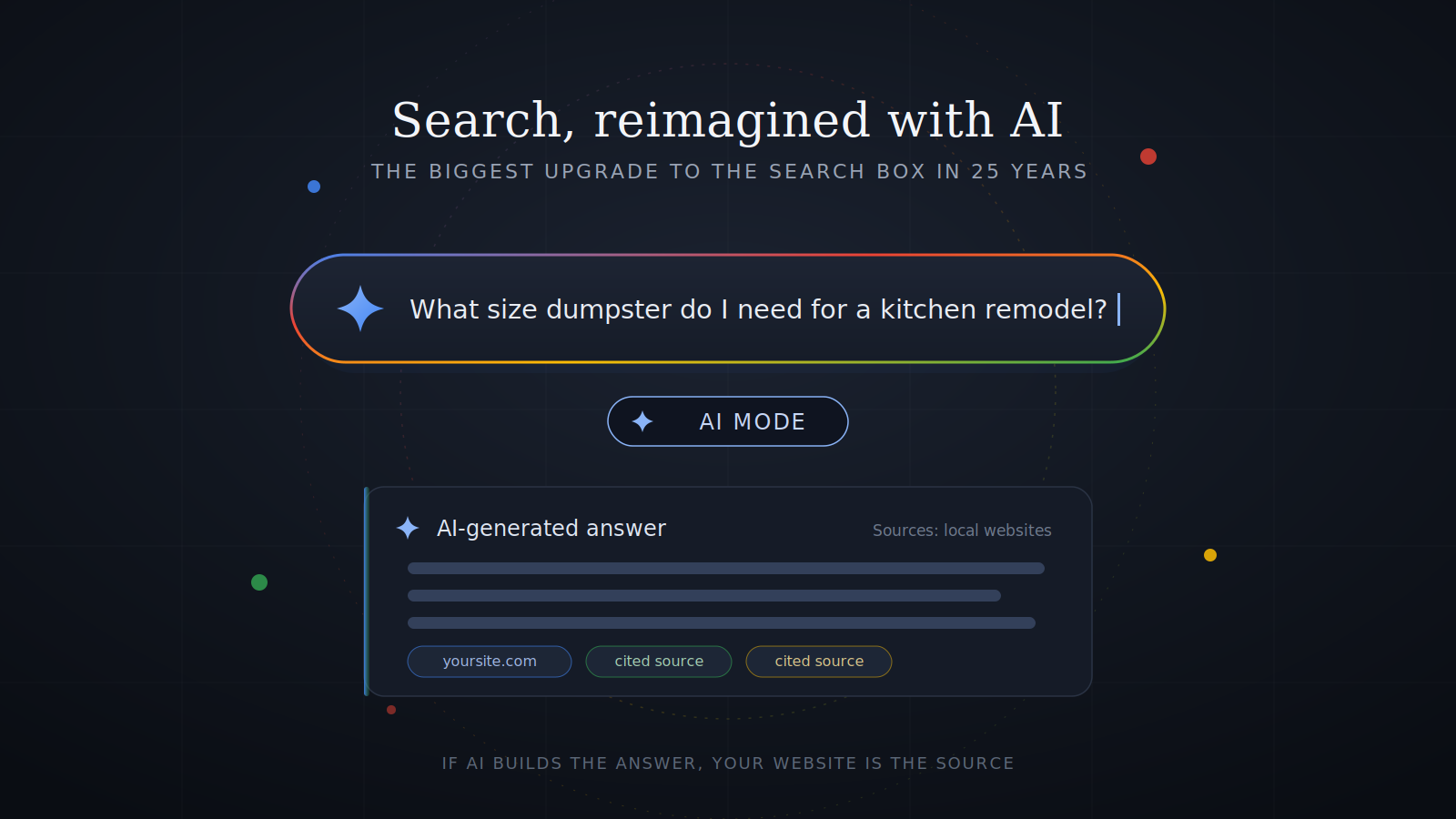
Google's shift to AI search changes how customers find dumpster rental companies. Learn why your website is now your most important marketing asset.
Search "dumpster rental" plus the name of your town. Count how many results on the first page belong to a company that actually owns trucks and containers in your area. For many independent haulers, the answer is uncomfortable. The top spots go to national brokers and lead-generation sites with a page for every city in the country. Some of those jobs end up back with you anyway, as a subcontracted order at a price the broker set, with the broker keeping a cut and the customer relationship. You own the equipment, you know the local roads and permit rules, and you do the work. The broker owns the search result. That can be changed. Brokers win on scale, but scale has limits. They can't show the local proof, speed, and accountability that a real local company can. This post shows how to find where brokers are beating you and how to take those searches back one town at a time. How Dumpster Brokers Work and Why They Rank Dumpster brokers generally don't own a fleet in your market. They take the order online or by phone, then send it to a local hauler to fulfill. Some sell the same lead to several haulers at once. Either way, the broker earns money from the gap between what the customer pays and what the hauler receives. They rank well for a few reasons: Large, established websites. A national site that has been building links for years carries a lot of authority with Google. A page for every town. Brokers publish thousands of city pages. Even thin pages can rank when the domain behind them is strong. Big ad budgets. They can afford to bid on nearly every dumpster keyword in every market. Sometimes, questionable Maps listings. Some lead-generation operations create Google Business Profiles at addresses where no real dumpster business operates. Trying to beat them on scale is a losing fight. Beating them on local detail is where you win. Step 1: Map Where Brokers Are Beating You Before changing anything, find out exactly where you're losing. Pick your 10 most important searches and check them for each of your main towns. Searches to check (adjust to your market): dumpster rental [town] roll off dumpster [town] 20 yard dumpster [town] dumpster rental near me (searched from that town, or with a location tool) cheap dumpster rental [town] For each search, write down: Who holds the top Google Ads spots Who shows up in the Map Pack Who ranks in the top five organic results Whether each one is a local hauler or a broker Use a private or incognito browser window so your own search history doesn't skew the results. Put everything in a simple spreadsheet. After an hour you'll have a clear picture of which towns and keywords brokers control, and where you're already close to the top. Step 2: Report Maps Listings That Break Google's Rules Google's guidelines require a Business Profile to represent a real business that serves customers in person. A listing created only to capture leads for resale, or placed at an address where no real business operates, may not meet those rules. If you find a listing that looks suspicious: Check the address on Street View. Is it a residence, a mailbox store, or an empty lot with no sign of a dumpster business? Call the number and ask a few simple questions. Who owns the trucks? Where is the yard? Who will actually deliver? If the listing clearly breaks the rules, use "Suggest an edit" on the listing or submit Google's Business Redressal Complaint Form with your evidence. Be careful and fair here. Only report listings you have good reason to believe are fake or misleading. Reporting a real competitor because they outrank you is a waste of time and can hurt your credibility with Google. Step 3: Build Town Pages Brokers Can't Copy A broker's city page usually says the same thing for every town with only the name changed. Your town pages should include details that only a company working in that area would know. What to put on each town page: Where you're located. Name your yard location and the drive time to that town. For example (use your own details): "Our yard is 12 minutes from downtown Springfield, so most deliveries arrive the same day." Local permit rules. Explain whether a street placement needs a permit in that town and how to get one. Neighborhoods you serve. List them by name. Photos from real jobs in that town. Include a short caption with the project type. Local disposal knowledge. Mention how you handle materials that the local transfer station or landfill treats differently, such as yard waste or concrete. A review from a customer in that town, if you have one. A broker can publish ten thousand pages, but it can't photograph your containers on driveways in your towns. That kind of local proof is hard to fake, and it gives both customers and search engines a clear reason to choose you. Start with your most profitable towns from Step 1 instead of trying to build every page at once. A few strong pages beat dozens of thin ones. Step 4: Make "Book Direct With the Local Hauler" Your Selling Point Many customers don't know the difference between a broker and a local hauler until something goes wrong. A different company shows up than the one they called, or they can't reach anyone who knows the status of their delivery. You can make that difference clear without attacking anyone. Ways to show you're the real local company: Say it plainly on your homepage and ads. For example: "Locally owned. Our trucks, our containers, our drivers." Adjust the wording to fit your business. Show your people and equipment. Use real photos of your team, your trucks, and your yard instead of stock images. Publish a "Why Book Direct" page. Explain the benefits in plain terms: one company from quote to pickup, a direct phone line to dispatch, local knowledge of permits and placement, and no middleman in the price. Use your name when you answer the phone. Answering with your company name and speaking directly about scheduling builds trust right away. Keep the message focused on what you offer. Customers respond better to a clear promise than to criticism of competitors. Want to see exactly where brokers are taking your searches? In a Free Strategy Session , we'll map broker competition across your service area and show you which towns you can win back first. Step 5: Compete Where Brokers Are Weakest Brokers are built for volume. That leaves gaps a local operator can fill: Speed. You control your own schedule. If you can deliver same day or next day, say it everywhere and back it up. Clear pricing. Show your price range, rental period, weight allowance, and overage fees upfront. Customers comparing options appreciate knowing exactly what they'll pay and who they'll pay. Flexibility. You can make judgment calls a broker can't, like extending a rental by a day, fitting a container into a tight driveway, or swapping a size on short notice. Accountability. When something goes wrong, the customer talks to the company that can fix it. Pick the two or three strengths that fit your business best and repeat them across your website, ads, and phone conversations. Step 6: Use Paid Search Where It Counts You can't outspend a national broker across every keyword and town, and you don't need to. Focus your paid budget where your local advantage is strongest. Bid on your own brand name. Brokers and competitors sometimes bid on local company names. A small brand campaign makes sure customers searching for you find you first. Target your core towns tightly. Concentrate your budget on the towns closest to your yard, where you can deliver fastest and profit most. Write ads that say "local." Mention your town, your fleet, and your delivery speed in the headlines. Send clicks to your town pages, not your homepage, so the ad and the page match the customer's search. Step 7: Earn Local Links and Mentions Brokers Can't Get National brokers collect links at a national scale. What they rarely have is real standing in your community. Those local signals help you in both search and Maps. Local link and mention ideas: Membership in your chamber of commerce and local business associations Sponsoring a youth sports team, community cleanup, or school event Vendor or partner pages from local roofers, remodelers, and property managers Coverage in local news when you donate a container or help after a storm Listings with your city or county as a waste hauling vendor, if they offer one Each one is a small signal on its own. Together, they tell Google you're a real part of the community in a way a national broker isn't. Should You Accept Broker Jobs at All? This is a business decision, and there's no single right answer. Broker work can fill empty containers during slow weeks. But it usually comes with lower margins, less control over pricing, and a customer who remembers the broker's name, not yours. If you take broker jobs, set some rules: Track the real margin on every broker job after fuel, dump fees, and driver time. Use broker work to fill gaps, not as your main source of bookings. Deliver excellent service anyway. Leave a door hanger or magnet with your company name so the customer can book direct next time, as long as your agreement with the broker allows it. Watch your dependence. If broker jobs grow as a share of your business, treat it as a sign you need to invest more in direct bookings. The long-term goal is simple: every job you win directly is one the broker doesn't take a cut of. Take Back Your Towns National brokers have scale, but you have something they can't buy: a real local business with trucks, a yard, and people who know the area. Map where brokers are winning, report listings that break the rules, build town pages full of local detail, and make "book direct" a clear reason to choose you. If you'd like help taking those searches back, book a Free Strategy Session with Dumpster Marketing. We'll: Map where brokers and lead-generation sites outrank you across your service area Flag Maps listings that may break Google's guidelines Identify the towns and keywords you can win back first Build a plan to grow direct bookings and reduce your dependence on broker jobs Dumpster Marketing works only with dumpster rental, junk removal, and waste hauling companies. We help local haulers compete with national players and win. Book your Free Strategy Session at DumpsterMarketing.co
You pay for every click, but missed calls and slow callbacks send customers to competitors. Here's how dumpster rental companies stop losing bookings after the lead comes in